


Science Journalism Corner: Archaeologists Interpret New Findings on Ancient Chinese Bronze Swords
By Emily Ding
About 2,500 years ago, two rival kingdoms in what is now eastern China waged near-constant warfare. Called the states of Wu and Yue, they produced swords that became objects of renown—and in some cases, legend. The classic text Zhuangzi exalts the bronze swords of Wu and Yue as treasures so valuable their owners refrain from “using them frivolously, for their worth is inestimable."
Many of these blades have survived for millennia, and some even display little to no corrosion. How did ancient swordsmiths make weapons that endured for so long?
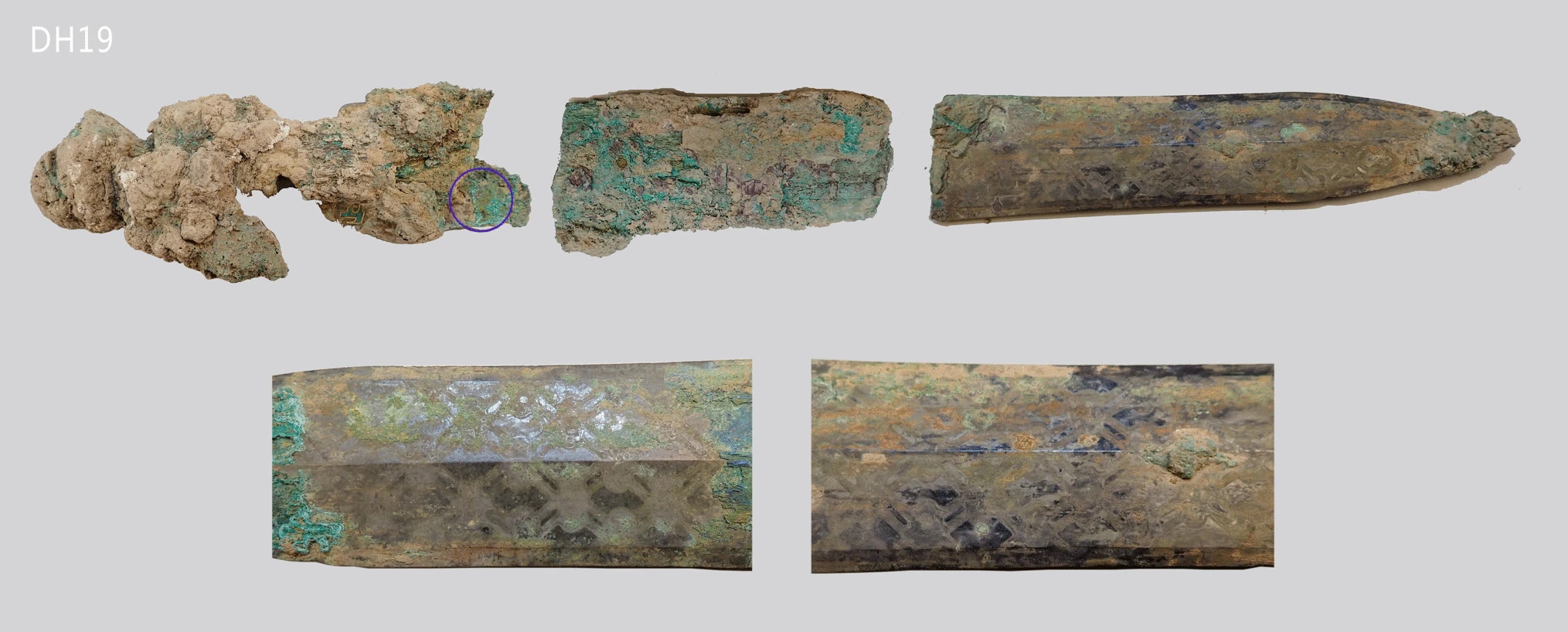
A recent study published in September 2025 in Archaeological and Anthropological Sciences offers an answer. A team of researchers from cultural heritage institutes in China’s Shandong Province uncovered a 2,500-year-old bronze sword in Tengzhou, a city in eastern China. They analyzed its surface using a suite of microscopic and experimental methods. Their findings reveal ancient swordsmiths engineered an ultra-thin, tin-rich layer on the blade’s surface. Previous studies have shown this layer, called a delta phase, can increase hardness and improve resistance to decay.
Form and Function
Adding tin to bronze increases hardness, but it also introduces one serious limitation: too much tin would make the blade less flexible and more prone to snapping. Weng Cheong Lam, an Assistant Professor of Archaeology at the Chinese University of Hong Kong, likens hardness and flexibility to “two ends of a spectrum.” For instance, a pencil is hard but not flexible, breaking easily when under pressure. A sword, Lam says, requires the best of both worlds.
Ancient swordsmiths therefore faced the challenge of how to balance these competing goals. Their solution, as the study explains, was to add a delta phase veneer to only the sword surface. This innovation hardened the surface while retaining the core’s flexibility.
To form this veneer, swordsmiths had to utilize a specific combination of metals and follow precise steps even modern metallurgists can struggle to recreate. But ancient swordsmiths showed incredible mastery of these methods. The study reveals “precisely what they’re doing and in what sequence—the chain of steps in metal production,” says Rowan Flad, a Professor of Archaeology at Harvard University.
The Chain of Steps
Bronze is an alloy, or mixture of metals, of primarily copper and tin. Ancient smiths formed the delta phase by applying a tin and iron-rich paste to a sword surface, which they engraved in a rhombic pattern. Upon heating the blade, the tin atoms diffuse into the copper-rich bronze and partially evaporate. This evaporation adjusts the tin concentration to the exact level needed for the delta phase to form. Finally, the smiths honed and polished the veneer to just 1–2 micrometers, or about one fiftieth the width of a human hair.
This delta phase manifests as dark rhombic patterns crisscrossing the sword’s surface. Flad calls this feature a reflection of the “intentionality of decoration for functional purposes.”
Swordsmiths developed their techniques over centuries of experimentation, striving for both functional performance and aesthetics. Master swordsmiths passed down their methods, training apprentices to create effective weaponry.
Even today, the swords represent remarkable technological sophistication. “I still cannot understand how the bronze smith understood this mechanism 2,500 years ago,” Lam adds, referring to the method behind forming the veneer. “At the end, I was amazed by the way that this process was eventually achieved.”
You can read the original study here:
Wang, Y., Dai, Q., Liu, Y. et al. The hardness-enhanced technique on the blade of bronze swords in the Wu and Yue States, China. Archaeol Anthropol Sci 17, 195 (2025). https://doi-org.ezp-prod1.hul.harvard.edu/10.1007/s12520-025-02303-6.